


Ball Sort - Color Puzzle Game
4.7223.00 Reviews
App Specs
- Version
- 1.1.0
- Updated On
- License
- Free
- Downloads
- 100,000+
- Developer
- SATORISYS PLAY
- Categories
- Casual
- Platform
- Android
Screenshots
 Analysis by AppCompare
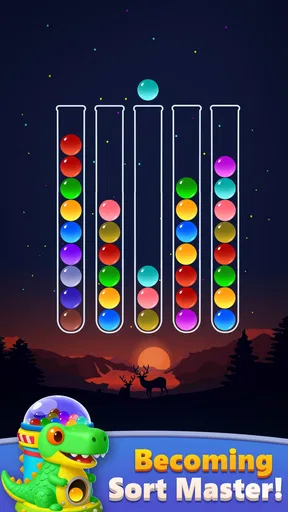
I opened Ball Sort - Color Puzzle Game expecting a simple way to fill a few spare minutes, and that is exactly where it fits best. The idea is familiar: colored balls are arranged in tubes, and I move them until each tube contains a single color. It takes seconds to understand, but the later decisions ask for more care than the cheerful presentation suggests. I found myself making one “quick” attempt, then replaying a level because I could see a cleaner solution just one move away.
This is a casual game from SATORISYS PLAY, available free of charge for everyone. Its audience is broad, but the experience is especially comfortable for people who enjoy quiet sorting puzzles rather than fast reactions, complicated stories, or competitive pressure. The game has reached over 100 thousand installs and holds a 4.7 average from around 6.2 thousand ratings, which matches my impression that its straightforward format is easy to pick up.
What the first few minutes feel like
The opening experience is refreshingly direct. I did not need to learn a character, understand a map, or remember a long list of rules. The central action is moving a top ball from one tube to another, with the useful restriction that a ball can only be placed on the same color or into an empty space. That small rule creates the whole puzzle: every apparently harmless move can affect the space I need two or three turns later.
For a first-time player, the most important expectation is that this is not a reflex game. The colorful balls may make it look playful and immediate, but success comes from pausing before touching the screen. I get better results when I scan the tubes first, identify which colors are partly exposed, and then decide where an empty tube should be used. Rushing is possible, but it usually creates extra rearranging.
The game also suits different kinds of short sessions. I can play while waiting for an appointment, take one puzzle during a break, or spend longer working through a run of increasingly demanding arrangements. It does not require the emotional commitment of a larger mobile game. That is a real advantage for anyone who wants a small mental exercise instead of another app competing for daily attention.
At the same time, players looking for constant novelty should keep their expectations realistic. The appeal comes from arranging colors under restrictions, not from a changing world, a narrative, or a large collection of unrelated activities. If you already know that sorting puzzles lose their charm after several rounds, this will probably not change your mind. Its strength is focused simplicity, and that focus can also feel narrow.
Getting started without overthinking the setup
The game runs on Android from version 7.1 onward, so it is accessible on many older devices as well as newer ones. I appreciate that this kind of puzzle does not demand a powerful phone to make sense. The current release is version 1.1.0, and the basic presentation keeps attention on the tubes rather than burying the play area under unnecessary decoration.
Worth Reading Before You Choose

EA SPORTS FC Mobile 26 Is a Bigger Football Game, but It Takes Time

Flipboard Shows What News Apps Must Do Beyond the Feed

Switching to Android Auto Means Rethinking Your Driving Routine

Google Calendar Makes a Crowded Week Easier to Manage

Ludo King Makes the Most of the Minutes Between Plans

Baby Panda World Brings Quick Play to Modern Phones, but Its Game Library Feels Busy
My advice after opening it is simple: begin with the first available puzzle and resist trying to predict the entire solution. Look for a color that is already exposed at the top of a tube. If another tube has the same color with room available, that is often a safe opening move. If no matching destination is obvious, an empty tube becomes the temporary workspace that lets the hidden colors emerge.
That first scan is more useful than memorizing a fixed sequence. The arrangement itself determines the right order, so a move that works beautifully in one puzzle may be wasteful in the next. I treat each tube as a stack: only the upper ball is immediately available, and uncovering the next one is often the real goal of a move.
One practical habit made the early levels much less confusing for me. Before moving anything, I mentally mark the tubes that contain repeated colors and the tubes that are nearly full. Repeated colors suggest a destination, while nearly full tubes warn me that I have little room for mistakes. This takes only a moment, but it prevents the common beginner error of filling an empty tube too quickly with a color that will soon need to move again.
The first meaningful success
The first satisfying breakthrough usually comes when I stop thinking of a move as “putting a ball somewhere” and start thinking of it as opening access. Suppose the top ball is not useful by itself. Moving it to a matching color may reveal another ball, and that newly exposed ball can change the entire plan. The best move is often the one that gives information, not the one that immediately makes a tube look tidy.
When I reach a nearly solved position, I slow down again. It is tempting to complete one color and assume the rest will follow automatically, but a finished tube can also remove valuable working space if I have used the available room poorly. I try to preserve at least one flexible destination until the remaining colors are easier to separate. This is one of the most useful lessons for someone coming from very simple matching games.
Another helpful technique is to avoid breaking a clean pair unless there is a clear reason. A pair of identical balls gives me structure and can serve as a destination for another matching ball. Moving those balls away may expose something interesting, but it can also turn a stable part of the puzzle into extra work. I only disturb a useful pair when doing so opens a color that is blocking several better moves.
If I make a poor decision, I do not immediately assume the puzzle is impossible. I retrace the last few moves mentally and look for the point where I used the final empty space or covered a needed color. In a sorting game, failure often comes from one early commitment rather than from the whole arrangement being beyond reach. That perspective keeps the experience calm instead of turning every mistake into a reason to quit.
Where new players commonly get stuck
The biggest source of confusion is the difference between a visually attractive move and a strategically useful one. Combining two matching balls feels productive, and often it is, but the destination tube may later be needed for another color’s temporary storage. I have learned to ask two questions before moving: does this expose something important, and where will the next blocked ball go?
Players can also misread an empty tube as a permanent home. I see it more as a parking space. Filling it with one color may be correct, but it may also be the only way to move a troublesome stack elsewhere. Keeping that option open is particularly valuable when several tubes have mixed colors and only one or two spaces remain available.
Color recognition can become less comfortable when similar shades appear close together, especially on a small screen or in bright surroundings. I recommend increasing attention to the position and surrounding balls rather than relying on color alone. If two shades look alike, compare them with the balls already grouped in the tubes and avoid making a quick transfer based only on a glance.
Another mistake is planning too far ahead. I used to imagine a complete solution from the initial arrangement, but one overlooked ball would invalidate the whole chain. A better approach is to plan two or three moves at a time, then rescan the board after each important transfer. This keeps the mental load manageable and makes the game feel more like controlled problem-solving than guesswork.
There is also a difference between being stuck and needing a reset in your thinking. When no move looks good, I pause and inspect the top of every tube again. Sometimes the useful option is not the most obvious matching pair; it is a temporary move that uncovers a color needed elsewhere. If the position still feels closed, restarting the puzzle is more sensible than repeatedly making random transfers. Random play usually consumes the remaining flexibility without teaching me anything.
Small strategies that make a real difference
My preferred opening is to search for a move that reduces blockage while preserving space. I prioritize a top ball that is sitting above a color I want to reach, especially if it can be placed onto a matching stack without disturbing another useful arrangement. This is more reliable than always completing the first pair I notice.
I also count available room informally. I do not need exact arithmetic; I simply notice which tubes are close to full and which ones can accept a temporary stack. When the board becomes crowded, I stop making moves that create a new mixed tube unless that mix is necessary. A mixed tube can be useful as a bridge, but too many bridges leave me with no clear destination.
One non-obvious trade-off is that a partially completed color can be more valuable than a finished color. A tube with two matching balls and open capacity may help absorb another ball later, while a completed tube may no longer contribute to rearrangement. I therefore avoid celebrating a finished tube too early. The visible progress is encouraging, but flexible progress is often stronger.
A second useful insight is to protect the color that is hardest to access. If a particular shade is buried beneath several others, I treat the surrounding balls as obstacles and plan around them. Moving unrelated colors into convenient-looking spaces can make that buried color even harder to reach. Instead, I try to create a route toward it before filling the nearby tubes.
A third insight concerns the end of a puzzle. The final few transfers are not always automatic because the order of the remaining stacks matters. I leave room for the last exposed color and avoid using every empty space simply to make the board look organized. A little disorder can be strategically healthier than a neat but locked position.
How it fits into everyday use
I can imagine using this during a short commute as a passenger, while waiting for food, or between tasks when I want something more engaging than scrolling. It works particularly well for people who need a gentle change of focus. I can play a puzzle, put the phone down, and return to what I was doing without feeling that I have abandoned a complicated session.
It is also a reasonable choice for families because the content rating is Everyone and the rules are easy to explain. A parent can show a child how matching colors work, then let the child experiment with the tubes. Younger players may need help with planning rather than with the controls. Adults who enjoy logic puzzles may find the early interaction very accessible, while children can approach it as a hands-on color activity.
For someone who wants a relaxing bedtime game, the slow pace is a good match, although puzzle-solving can still become mentally active when a board is difficult. I would avoid starting a challenging level if I know I need to sleep immediately; the simple interface makes it easy to say “one more attempt.” That is not a flaw unique to this game, but the short-session format makes the temptation especially strong.
Compared with match-three games, this offers less visual excitement and less moment-to-moment reward, but it gives me more control over the outcome. Compared with word puzzles, it avoids language dependence and works through visual grouping. Compared with larger logic games, it has a smaller learning curve and less variety. The right alternative depends on whether I want calm spatial planning, quick spectacle, vocabulary practice, or a broader puzzle collection.
Who should try it, and who should skip it
I would recommend this game to first-time puzzle players, people who like organizing objects, and anyone looking for a free casual title that can be understood immediately. It is especially suitable if you enjoy solving at your own pace and are comfortable replaying a position after a mistaken decision. The free price removes the usual barrier to trying it, and the Everyone rating makes it easy to consider for shared devices.
I would be more cautious about recommending it to players who need a story, character progression, multiplayer competition, or a constant stream of new mechanics. The core activity remains sorting balls into matching groups. That consistency is what makes the game approachable, but it also means the experience may feel repetitive to someone who expects frequent surprises.
It may also be a poor fit if you dislike visual repetition or if color-based distinctions are difficult for you to read. In that situation, a puzzle built around numbers, words, or clearly shaped symbols could be more comfortable. I would not choose this as my main game for a long flight or a full evening unless I already knew that sorting puzzles held my attention for that long.
My next-step advice after the first win
After completing the first successful puzzle, I suggest changing one habit rather than simply playing faster: begin each new board with a full scan. Identify the exposed colors, note the available empty space, and decide which tube is most dangerous to disturb. This turns the game from casual tapping into a repeatable method, and it makes later challenges feel fairer.
If a level becomes frustrating, take a short break instead of forcing random moves. Returning with fresh attention often reveals that the problem was an overlooked opening, not a lack of ability. I also find it useful to replay a puzzle mentally after solving it and ask which early move created the most freedom. That small review improves future decisions without requiring a separate tutorial.
My overall impression is positive because the game knows what it wants to be. It is a focused color-sorting puzzle with an inviting entry point, low technical demands, and enough planning to reward patience. The experience is not built for players seeking deep variety, but for a quiet break or a first step into logic games, it is easy to recommend. I would install it when I wanted a clean, approachable challenge and keep it available for those moments when a few minutes of orderly thinking sound better than another round of passive scrolling.
Pros
- Simple drag-and-drop controls are easy for players of all ages.
- Short levels make it convenient for quick breaks or casual play.
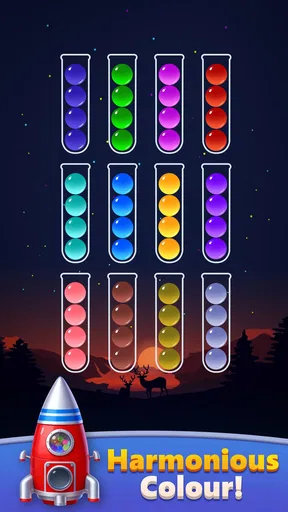
- Colorful visuals make the tubes and balls easy to distinguish.
- Gradual difficulty provides a gentle introduction for new players.
- Offline play is useful when traveling or without a stable connection.
Cons
- Later puzzles can feel repetitive because the core mechanic rarely changes.
- A single mistaken move may require restarting an otherwise lengthy level.
- Color perception can be difficult for some players on similar shades.
- Frequent hints or undo use may reduce the challenge for experienced players.
- Ads may interrupt the flow
- especially between completed puzzles.
FAQs for Ball Sort - Color Puzzle Game
What is Ball Sort - Color Puzzle Game, and how is it played?
Ball Sort - Color Puzzle Game is a casual logic game based on organizing colored balls inside tubes. Your objective is to move balls between tubes until every tube contains balls of only one color. You can usually move a ball only onto another ball of the same color or into an empty tube, so each level requires planning, patience, and careful use of the available space.
Is Ball Sort - Color Puzzle Game suitable for beginners?
Yes, the game is generally easy to understand and suitable for beginners because its controls are simple and the early levels introduce the rules gradually. However, later puzzles can become considerably more challenging, especially when several colors and limited empty tubes are involved. It is a good choice for players who enjoy relaxed gameplay but still want occasional mental challenges.
Does Ball Sort - Color Puzzle Game work without an internet connection?
Ball Sort - Color Puzzle Game is primarily a single-player puzzle experience, and the main sorting levels can often be played without a continuous internet connection. Offline availability may vary depending on the version, device, advertisements, and optional features. If you want to play while traveling or without mobile data, it is best to test the game after installation with Wi-Fi and mobile data disabled.
Are there advertisements or in-app purchases in Ball Sort - Color Puzzle Game?
Like many free-to-download puzzle games, Ball Sort may include advertisements, commonly appearing between levels or when players request extra assistance. Some versions may also offer optional purchases, such as removing ads, obtaining hints, or receiving additional tools. The exact pricing and advertising frequency can change with updates, so check the store listing before downloading if cost and interruptions are important to you.
What should I do if I make a wrong move or get stuck on a level?
If a level becomes unsolvable, many versions provide options such as undoing recent moves, restarting the puzzle, or using hints. Even without assistance, restarting is usually quick and allows you to try a different order of moves. The most effective strategy is to avoid filling a tube too early, preserve at least one empty space when possible, and uncover hidden colors gradually rather than moving balls randomly.


